
Codiatech Blog
Cloudflare D1 and AI Search: access and freshness for business assistants
The D1 connector is now in beta. We examine the tests a business knowledge assistant needs for information scope, content withdrawal and access boundaries.

A business knowledge assistant needs more than a useful answer: it needs a clear rule for which records may support that answer, and when outdated information stops being available. In its November 12, 2026 announcement, Cloudflare introduced a beta D1 database source for AI Search. Each row returned by a supplied read-only query becomes a document; scheduled synchronization tracks changes.
Define the information boundary before connecting the database
For a CMS, help center or product catalog, evaluating a database connector should not begin by exposing every table to an assistant. Our recommendation is to write down the questions the assistant should answer alongside the records it may use. A public product description and an account-specific contract have different access requirements. Keeping both in one application does not make them suitable for the same retrieval pool.
A hypothetical pilot could start with published help articles only. This is an example, not a claim about a customer deployment or an existing integration. The content owner should approve which records are public and which fields may appear in an answer. Internal notes, draft commentary and personal contact details should remain outside the initial scope; review that decision whenever the selected fields change.
Unpublishing needs its own acceptance test
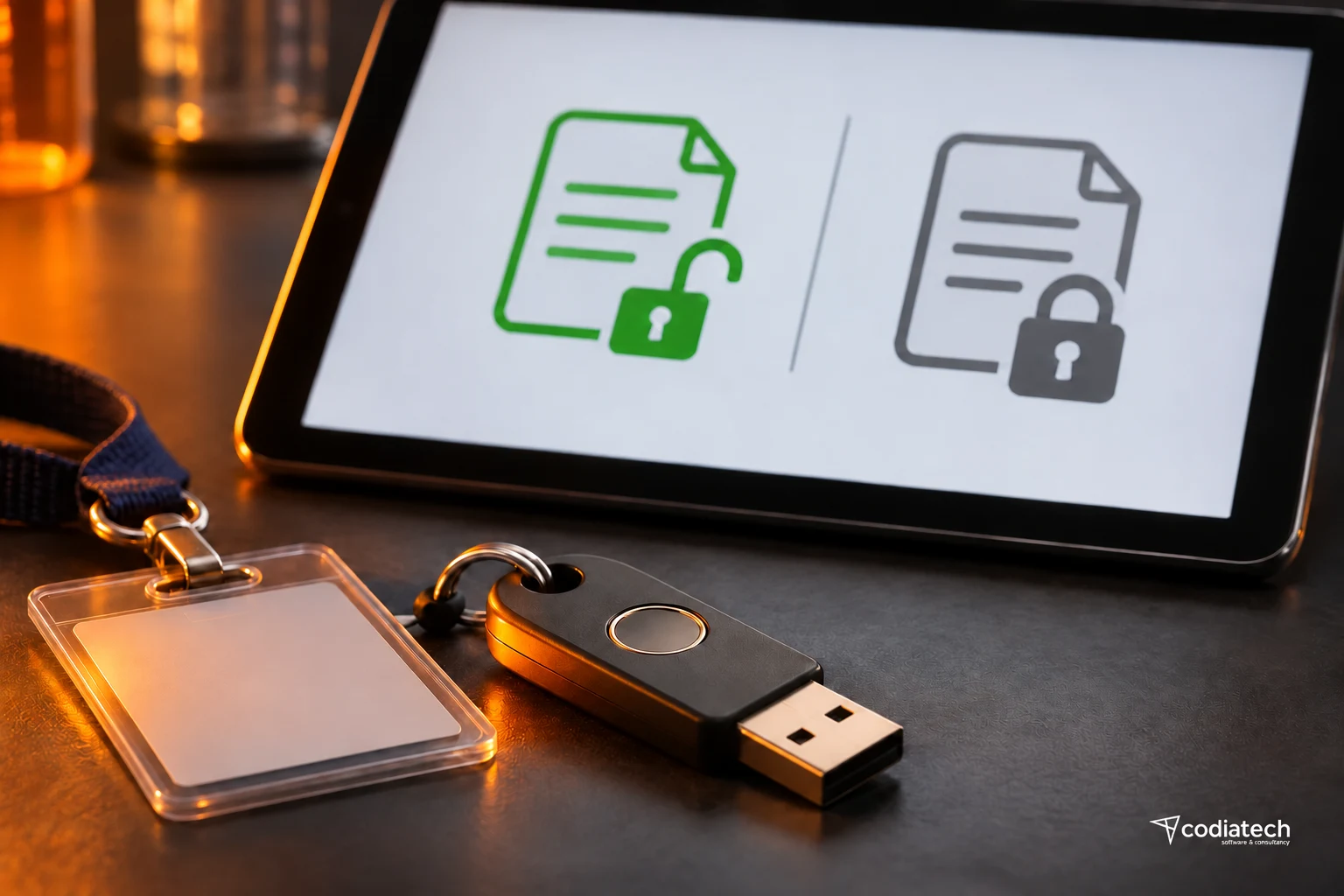
The official D1 source documentation says records disappear from the index only after a full result is read. If a query fails or returns zero rows, synchronization errors out and retains indexed items. Emptying the source therefore does not establish that its search copy has been cleared.
Our engineering recommendation is to treat removal as an end-to-end workflow rather than declaring success when the CMS status changes. Publish a test record in a staging environment, search for a distinctive sentence, withdraw the record, and repeat the search. Examine the retrieved result, generated answer and citation together. Record the expected behavior for every relevant access path instead of relying on a single unsuccessful search.
Test the removal of the last published record separately. Decide in advance what the application should do when synchronization fails: suppress answers known to be stale, temporarily disable affected sources, or refer the request to a person. Any chosen fallback must be demonstrated in the pilot. These are design options to evaluate, not features we claim the connector automatically supplies.
A retrieval filter does not establish user authorization
For internal systems or applications serving multiple organizations, we recommend authenticating the user and enforcing data access in the application layer. A tenant name or filter submitted by a client does not prove that the user is entitled to that tenant's information. Derive access decisions from a verified session and enforce them on the server.
A useful test goes beyond a successful search by an authorized user. Try another organization's record identifier, a different role and an unauthenticated request. Inspect both search results and generated answers for the expected denial. Even when the answer itself is blocked, a source title or link can reveal information. These are general architecture checks; the existence of a database connection does not demonstrate that they have passed.
Write acceptance criteria that can be repeated
Source accuracy: prepare a question set with expected records and examples of unacceptable answers. Open each cited source and check whether the answer actually follows from it.
Freshness: change a record, then search for the previous and replacement wording separately. Define an acceptable update window from the business requirement and record the observed delay.
Access boundaries: repeat the same question under at least two roles and a user without access. Keep enough diagnostic evidence to identify the failing layer without unnecessarily logging sensitive document bodies.
Failure and recovery: exercise a controlled connection failure. Name the operational owner, the user-facing state and the steps for returning to the previous workflow.
When is a pilot worth considering?
Start with the fit between the data source, publishing process and access model. If the information currently lives in another system, a new connector announcement is not, by itself, a reason to migrate it. Review maintenance ownership, data-processing requirements and current usage costs separately. Do not make production dependent on beta functionality before accepting its suitability for the project.
For AI-powered systems, Codiatech considers information access, human oversight and operating responsibilities. In system integration, the focus is how data moves between existing applications. This article does not describe a customer installation. The most useful starting deliverable is an approved information boundary and a repeatable acceptance test, rather than a list of technologies.
Sources
Cloudflare: AI Search supports D1 databases as a data source (beta) — November 12, 2026.
Cloudflare AI Search: D1 source documentation — synchronization behavior, checked November 13, 2026.
Primary source: developers.cloudflare.com