
Codiatech Blog
Route 53 Advanced: A Control Plan for DNS Changes
How should businesses assess Route 53 Advanced? Review deletion safeguard limits, record ownership, pilot evidence and a practical recovery plan before changing DNS operations.
What Does the November 20 DNS Announcement Change?
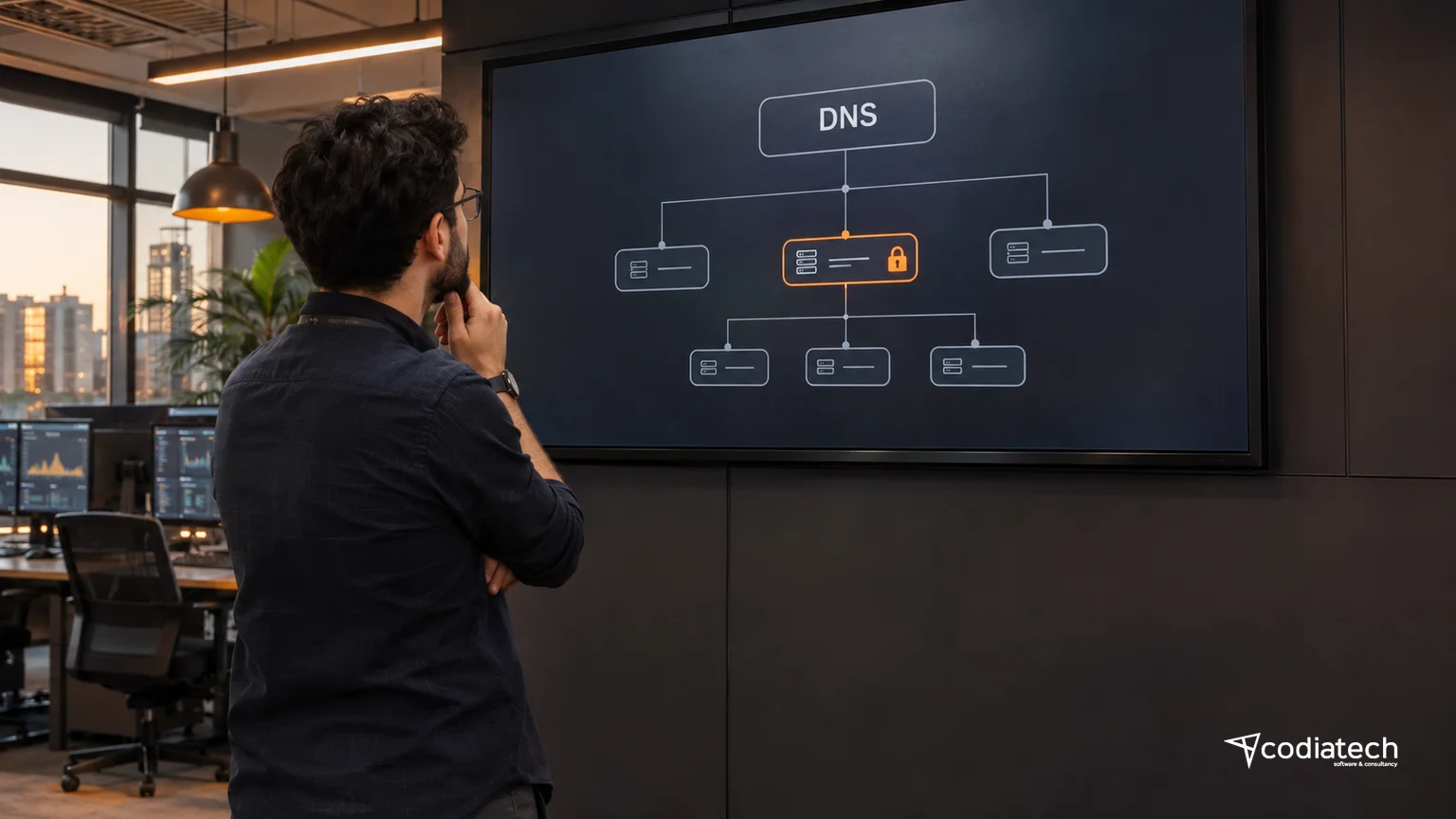
AWS’s November 20, 2026 announcement introduces the additional-cost Advanced Hosted Zones tier for Route 53. It includes optional deletion safeguards and 365 days of record change history. AWS announcement
The business decision extends beyond having another product option: which domain changes could interrupt work, who would notice an incorrect change, and who would coordinate recovery? The control plan below is Codiatech’s editorial recommendation. It describes no customer deployment, provider relationship or measured reduction in downtime. Its purpose is to assess where another control belongs within an existing operating process.

Identify the Workflows and Record Owners First
We would not start by upgrading every zone. Map the names used for the website, email, customer portal and application connections to their business functions. Record both the team requesting a change and the person who will verify its outcome. If nobody owns a record, put it into a dependency investigation rather than classifying it as unused.
Codiatech recommends an assessment table containing the record name and type, dependent application, current approval method, tool making the change and recovery owner. Prepare it with the possibility that domain registration, DNS hosting and application hosting have different owners. Access to the DNS console does not establish knowledge of every application dependency.
Prioritize names whose incorrect configuration could interrupt sales or daily work. In a hypothetical example, the customer portal name deserves a different assessment from an archived campaign subdomain. This illustrates prioritization and represents no actual customer environment. Writing down why a name matters connects the purchasing decision to an operating need rather than a feature list.
Read the Limits Against the Proposed Change
The technical documentation says the three Advanced deletion checks remain off until enabled. Changing record values is not deletion. Activity checks have limits for infrequently queried records and targets reached through CNAMEs. Change Guardrails documentation
Our recommendation is to avoid grouping every planned action under a generic DNS update. Use separate review questions for deletion, destination changes, new records and delegation. A control that stops deletion does not establish that an incorrect destination is safe. Retain the application tests and human review your environment needs; a protection indicator in the console should not become a blanket approval.
Prepare a written comparison of the values before and after the proposed operation. We recommend postponing a request if the expected difference is unclear. Where several records share a name, a second person can help verify that the intended record has been selected. This is an editorial process recommendation for reducing targeting mistakes, rather than an AWS requirement.
When a deletion guardrail is triggered, Route 53 rejects the entire change batch with InvalidChangeBatch; the other records in that batch remain unchanged. The pilot should therefore verify the batch outcome, not just the protected record. AWS error behavior
Test an Ordinary Change and a Rejected Request Separately
Select a test area independent of production, where deleting test data has no business impact. Do not attempt to delete a real business record merely to demonstrate a safeguard. The objective is to learn which result the team receives through its own tools. A console test alone does not establish that the automated deployment path produces the same usable acceptance evidence.
- Starting configuration: Record the selected tier and enabled controls. If the expected setting is absent, stop and investigate the scope.
- Allowed operation: Record a harmless test change. Even if the command reports success, check the expected DNS answer separately.
- Rejected operation: Compare the expected error with the observed result in a controlled deletion scenario. An unexpected acceptance is a reason to revisit configuration and test assumptions.
- Automation behavior: Check how the rejected request appears in the deployment workflow. If the error is hidden, address notification and stopping behavior before expanding adoption.
Connect Change History to a Recovery Procedure
The existence of a history record and readiness to recover are separate acceptance points. Codiatech recommends keeping a safe record of correct values and an application verification step before making a change. Exclude credentials and access keys. The record should let a colleague connect the technical change with the business request without searching unrelated conversations.
In a failure scenario, the responsible person should first identify the affected name and expected answer. They should then select the difference to reverse and the application owner who will verify recovery. Returning to an earlier value should not close the incident by itself; verify that the user can perform the required function again. If the discrepancy remains unexplained, continue investigating instead of stacking more changes onto the same area.
Use Pilot Evidence to Assess the Additional Cost
A decision note should connect the existing control gap, chosen pilot and intended operating improvement. Do not assess the additional charge solely by counting features. If the team cannot interpret a rejected request or identify the correct record, resolve ownership and inventory first. Another product tier cannot supply missing knowledge about the environment.
At the end of the pilot, the record owner, selected control, permitted operation, expected rejection and recovery step should all be explicit. Do not expand while the result remains uncertain. Resolve unexplained differences with the relevant automation or application team, then reconsider a limited scope. Define success as a reproducible check with clear responsibility, rather than simply enabling a feature.
Within Codiatech’s cloud management services, DNS dependencies and change responsibilities can be assessed according to project needs. This article reflects source checks on November 23, 2026. The announcement date was verified to the day; no exact publication time or time zone is asserted. Recheck current product scope and options in your organization’s account before implementation.
Primary Sources
Primary source: aws.amazon.com